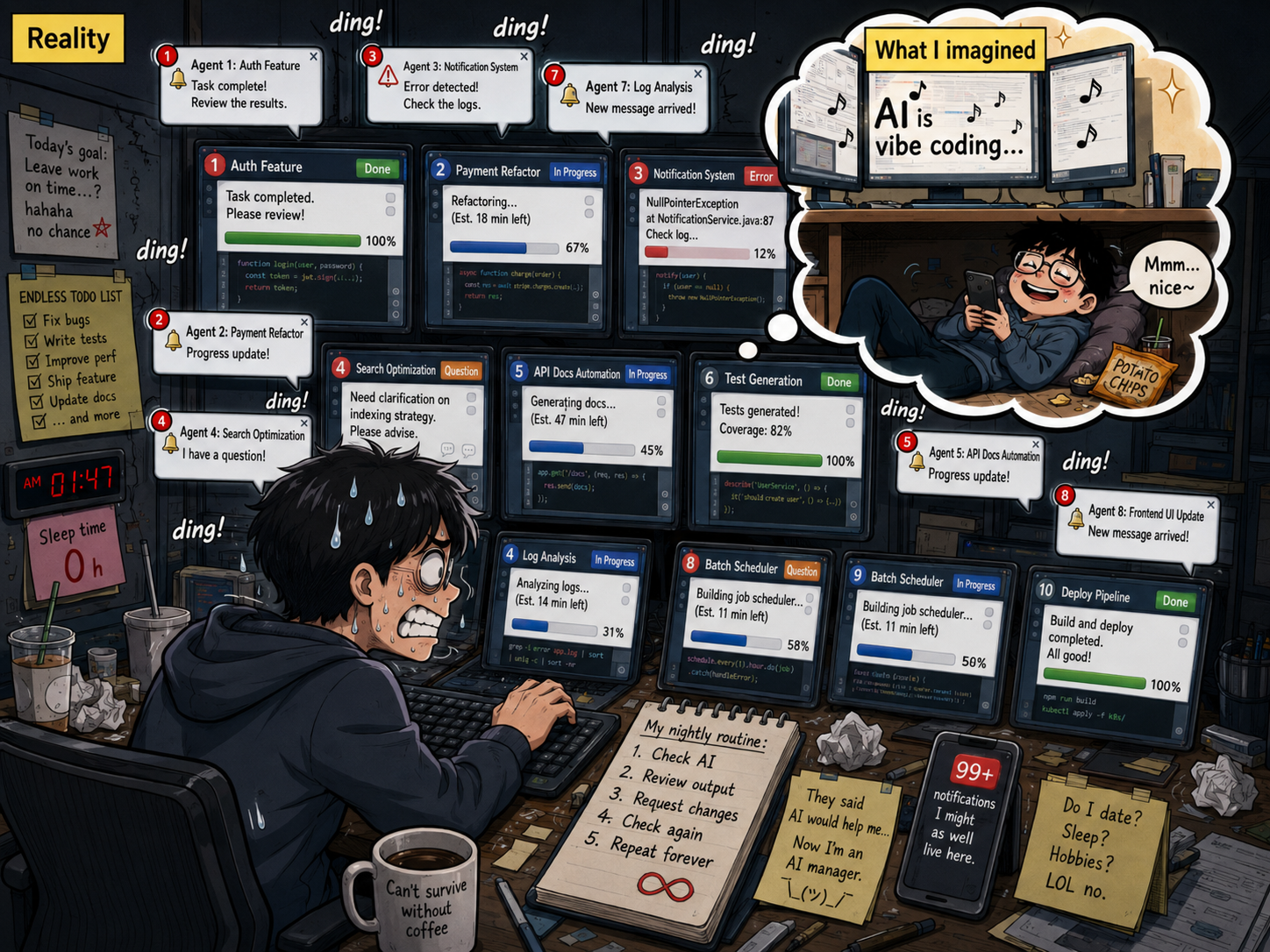
There’s a word you hear constantly in the AI world these days: the token. A token is the smallest unit of text an AI processes — roughly a word or a fragment of one — and it’s the meter by which AI usage is measured. Just as you read a sentence syllable by syllable, an AI reads and writes in tokens. And just as your electricity bill tracks what you consume, AI services charge by the number of tokens processed. Look closely at the world that has grown up around the token, though, and you find something at odds with the promise that AI would take work off our hands. Far from shrinking, the workload is, in a growing number of cases, getting bigger.
Start with cost. According to Stanford University’s AI Index, the price of processing tokens at a given level of performance fell from $20 per million tokens in November 2022 to just $0.07 by October 2024 — a 280-fold drop in about two years. You’d think a price collapse like that would lighten the bill for using AI. The opposite happened. Because tokens got cheap, people felt free to use far more of them, and consumption outran the price drop by a wide margin. In China, average daily token usage jumped from roughly 100 billion in early 2024 to more than 140 trillion by March 2026 — over a thousandfold in two years. Cheaper tokens didn’t translate into thrift; they translated into a much bigger appetite. It’s the same logic as water: make it cheap, and people don’t conserve it — they let the tap run.
On top of this sits a culture in which using more AI is treated as proof that you’re doing your job well. Nvidia CEO Jensen Huang said in a 2026 interview that he would be deeply alarmed if an engineer paid $500,000 a year spent only $5,000 on tokens — that person, he argued, ought to be burning through at least half their salary, $250,000 worth. Not using enough AI, he said, is like a chip designer insisting on drawing blueprints with pencil and paper instead of design software. He even floated handing engineers a token budget worth half their pay on top of it. As token usage becomes a stand-in for competence, some companies have folded it into performance reviews and hiring. One firm reportedly told managers they had to justify why a task couldn’t be done by AI before they were allowed to hire a person to do it.
At that point the worker’s incentive is obvious. Use too little and you look like you’re falling behind — so you start handing the AI work that never needed doing in the first place. A developer at one large software company admitted to assigning unnecessary tasks to AI simply to avoid being flagged for underusing it. It amounts to manufacturing work in order to be seen doing it: turning a one-line note into a padded report, routing a quick lookup through a multi-step workflow. Work that ought to be shrinking swells instead.
The deeper burden lies elsewhere. With the spread of “agents” — AI that, once instructed, runs on its own through many steps for hours at a stretch — the sheer volume of AI output has exploded. But someone still has to check whether that output is right. The making gets handed to the AI; the work of verifying it and owning the result stays with the human. An office worker who hands the meeting minutes to AI no longer writes them — instead they comb the AI’s draft for the parts that don’t match what was actually said. Run several agents at once and the pile to review grows in step. Your hands move less, but you can’t quite take them off the wheel.
Costs fell while usage exploded; using less hurts your standing, so work gets invented; and whatever gets produced still has to be reviewed, line by line, by a person. On top of that, every token takes real electricity and cooling water to process, so the bill — the literal one — grows with the volume. The claim that AI would do our work for us was half right. Some tasks genuinely vanished. But into the space they left moved a new kind of labor: using more, and checking more. That, at least, is the picture the token economy has drawn so far. The assumption that smarter tools would leave people with more time on their hands remains, for now, only half true.