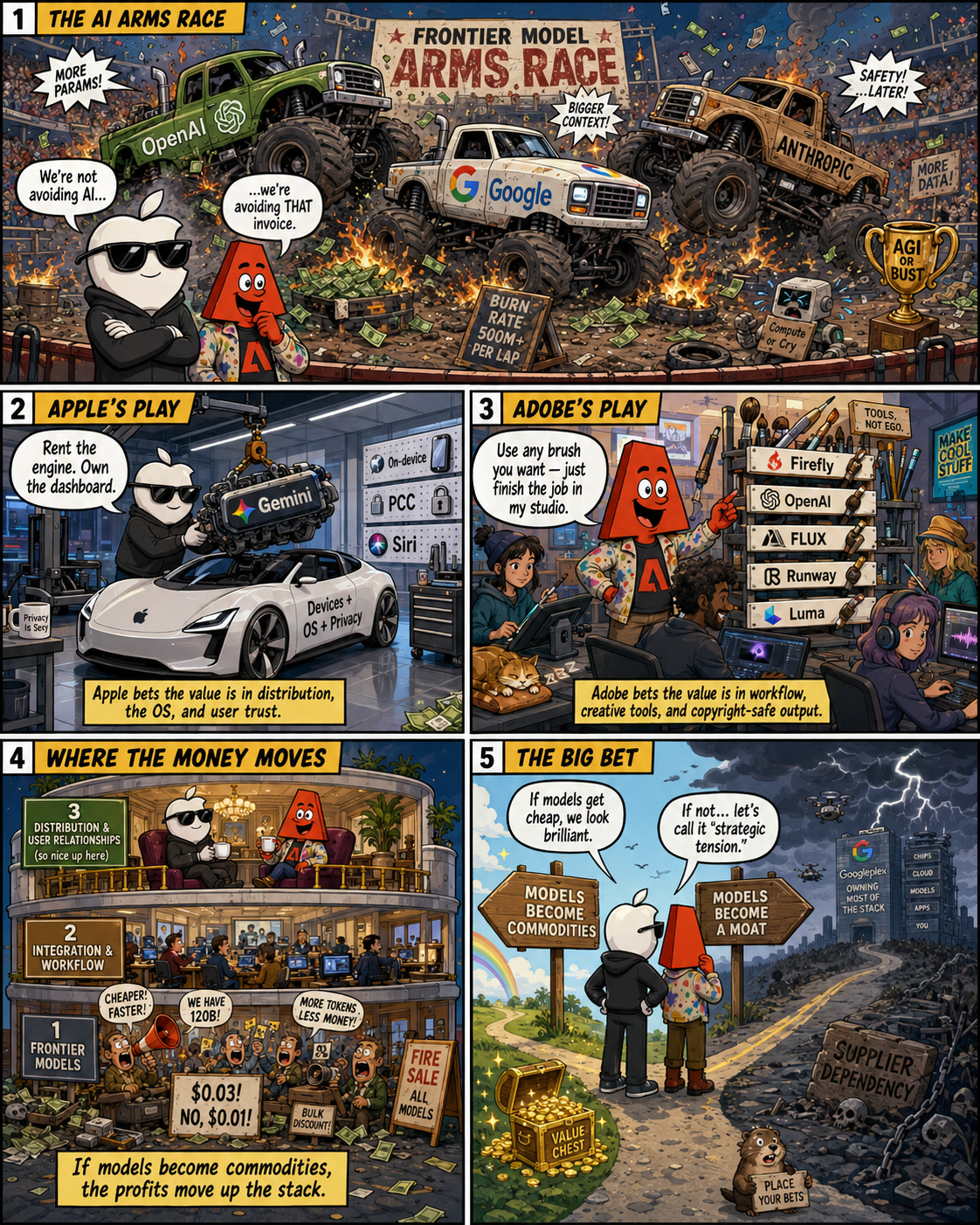
When ChatGPT arrived in late 2022, the questions about Apple came fast. Everyone else was racing to build large language models, so why was Apple just sitting there? Surely it would end up like Intel or IBM — giants of an earlier era left behind by the times. Intel had dominated the personal-computer age yet missed the shift to mobile and AI chips; IBM was once synonymous with “computer” but ceded the consumer market entirely. Apple, the thinking went, was next. And the doubt wasn’t only external: Craig Federighi, who runs Apple’s software, is described as deeply cost-conscious and wary of investments with uncertain payoffs. While rivals poured tens of billions into data centers and chips, Apple was in no hurry to build out AI infrastructure of its own.
But here’s the twist. Apple may have stayed out of building large language models, yet it happens to make some of the best hardware for running them. Apple’s chips fuse memory and processor into a single pool, so an entire large model can sit in memory at once. For running the biggest models on a personal machine, Apple silicon is now rated a match for — and sometimes better than — Nvidia’s graphics cards, and is even floated as an alternative to Nvidia. Put simply: Nvidia is where you build a model; Apple is where you run one.
A clarification is in order. Neither Apple nor Adobe — the other notable holdout — abandoned AI models altogether. Apple runs its own models on the device; Adobe runs its own models for generating images and video. What both companies declined to do is build, from scratch, the largest and most expensive general-purpose models, the kind that converse freely and reason about anything.
The reason is arithmetic. Analysts estimate that building and maintaining a frontier model from the ground up costs upward of $100 billion. A well-made model, by contrast, can be rented for far less. In January, Apple agreed to license Google’s model to power its new voice assistant, reportedly for around $1 billion a year. A rented model carries another advantage: when something better comes along, you simply swap it out, with no lock-in. And the price of using these models keeps falling while the lead keeps changing hands — one provider recently cut its rates by 67 percent, another by more than 70. Once anyone can reach similar performance cheaply, a model becomes a commodity, like electricity or tap water.
When that happens, value shifts away from the model itself toward how it is packaged and delivered. Apple had taken heat for promising a smarter assistant and then repeatedly delaying it; the Google deal is its way out. Its real weapons are the more than two billion devices in use worldwide, and its stance on privacy. Simple tasks are handled on the device, and only the heavy lifting goes outside — to servers Apple keeps walled off so the data never leaves its control. Apple’s capital spending this year runs around $14 billion, a small fraction of what the big cloud companies pour into AI infrastructure.
Adobe takes a different route. It keeps its own models, built to minimize copyright risk, while pulling dozens of rival models into its own platform for users to pick from. You explore ideas with outside models and finish production work with the safer in-house ones. In April it introduced an assistant that, given a spoken description of the result you want, operates Photoshop and Premiere on your behalf. Whatever model is in vogue, Adobe intends to own the place where a professional’s work gets finished. Even so, as a flood of new AI services for generating video and images stokes fears that creative labor itself is being upended, Adobe’s stock has fallen sharply over the past year — despite record earnings.
It comes down to one thing: whether the most advanced models truly become commodities. If they do, both companies reap large profits at low cost. If instead one model opens a lead no one can close, they will have handed off the era’s most important technology to someone else. Tellingly, the company lending Apple its model — Google — is the one rival that owns the hardware, the operating system, and a top model all at once. People once predicted Apple would follow Intel into decline. Instead, Apple chose to rent rather than build, and to defend the ground it knows best. Whether that bet pays off depends on whether models, in the end, turn out to be cheap and everywhere.